Description
Neons, Petra Hřebačková, 2026
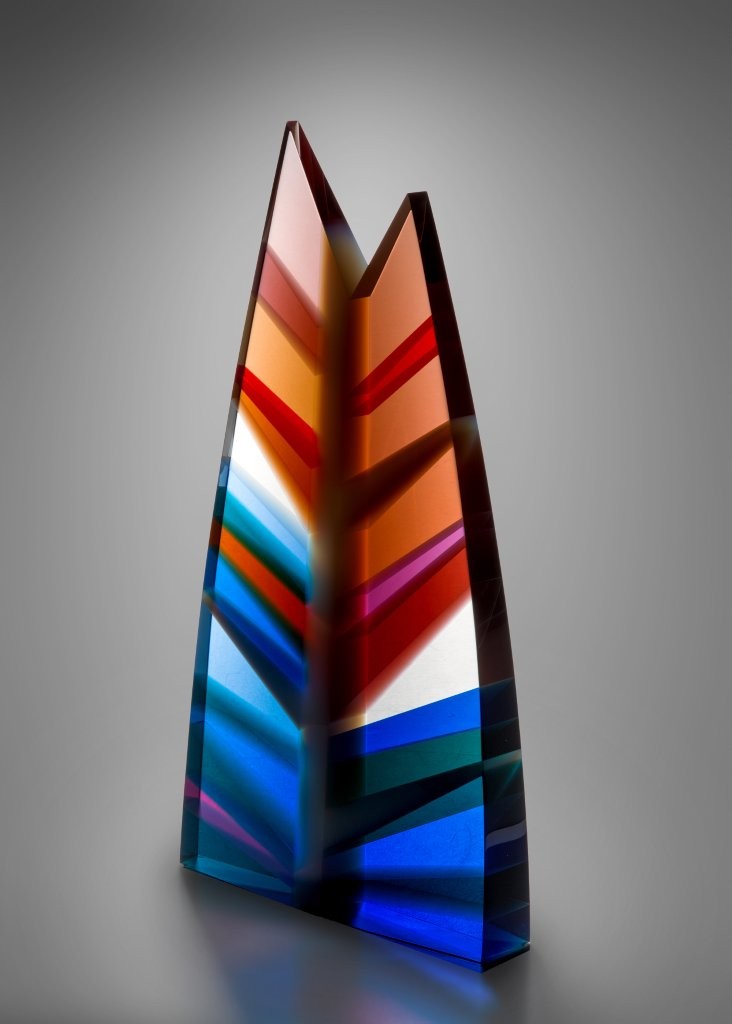
The work Neons from 2026 belongs to Petra Hřebačková’s most recent body of work and continues an artistic cycle that also includes her earlier piece Tequila. In the case of Tequila, the starting point was the microscopic appearance of the alcoholic drink, which the artist translated into the language of coloured glass, geometry and space.
In Neons, Petra Hřebačková continues working with a similar principle of abstracted structure, without requiring the viewer to search for a literal depiction of a specific source. What might originally resemble a fragment, cell, crystalline structure or coloured trace on a microscopic scale is here given physical mass, height and spatial presence.
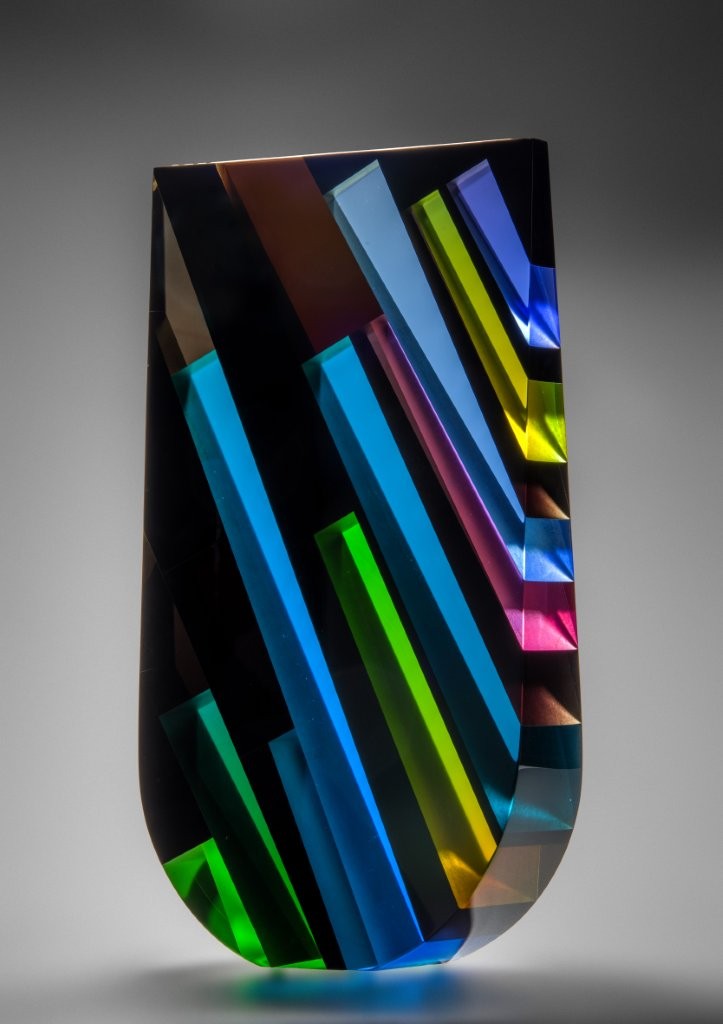
At first glance, the work attracts attention through a pronounced contrast. Bright elongated segments in blue, turquoise, green, yellow, pink and violet emerge from a dark glass body. Some run through almost the entire height of the object, while others appear only as shorter fragments. The result is an irregular rhythm that feels spontaneous yet at the same time highly controlled.
The title Neons accurately reflects the way the work uses colour. Against the dark base, the individual coloured elements appear almost as if they were emitting light of their own. Yet the object contains no internal light source. This effect is created entirely by the properties of transparent coloured glass, its thickness, the ground edges and the way surrounding light passes through the material.
Colour is not applied to the surface. It is enclosed within the mass of the glass itself. Viewed from the front, some segments appear almost graphic. As the viewing angle changes, however, their character shifts. Colour concentrates along the edges, some sections darken, while others become more intense. What from a distance looks like a system of coloured lines transforms at close range into a layered spatial construction.
The vivid coloured “bars” also give the work a distinctly contemporary, almost electric character. Although they may evoke neon tubes or illuminated signage, their artistic logic is rooted in the artist’s broader interest in structures that are not normally visible to the human eye.
Neons may appear like a spontaneously assembled composition, but its creation depends on highly precise planning of the individual parts. The coloured glass is kiln-cast in a mould and the separate elements are subsequently cold-bonded. Thermal processing and controlled cooling are followed by mechanical finishing, during which the individual planes and edges are given their final form.
Grinding is particularly important to the character of the work. It determines how light enters the material, how it reflects from the edges and where a coloured segment becomes optically stronger. In an object based on such pronounced geometric structure, even a small inaccuracy would disrupt the entire visual rhythm. Final polishing then optically opens the surface of the glass and allows the colours to achieve their maximum depth and intensity.
With dimensions of 35 × 20 × 6.5 cm, the work has a pronounced vertical proportion. It therefore functions particularly well on an independent plinth, console or chest of drawers, where it can be viewed approximately at eye level.
The work benefits from visually calm surroundings. Against a light background, the geometry of the individual segments and the contrast between the dark body and vivid colours become most apparent. A darker background, by contrast, can strengthen the impression that the coloured elements are genuinely glowing from within.
Side or focused lighting can create a particularly interesting effect by emphasising the thickness of the material and the individual coloured edges. Neons works well in a contemporary residential interior, study, entrance hall or representative space, where it can function as a strong yet refined visual accent.
For collectors, Neons is compelling not only because of its colour but also because of its place within the wider development of Petra Hřebačková’s work. Its connection to the cycle that includes Tequila reveals the artist’s longer-term interest in translating small or ordinarily invisible structures into powerful spatial forms in glass.
At the same time, Neons is a new work from 2026 presenting this artistic line in a contemporary form that is strongly geometric and chromatically intense. It is therefore more than simply an visually striking glass object. It is a work that brings together observation, abstraction, technical precision and the ability of glass to transform light into another active part of the composition. What may originally be almost invisible at its natural scale is here given volume, colour and physical presence.
More about the artist >>> here <<<