Description
Bohumil Eliáš Sr., Inhabitant, 2002
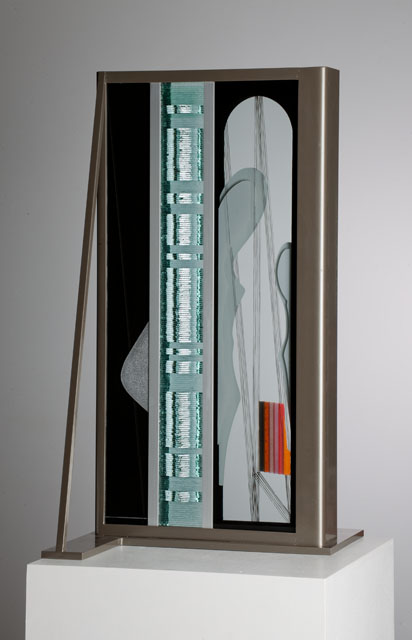
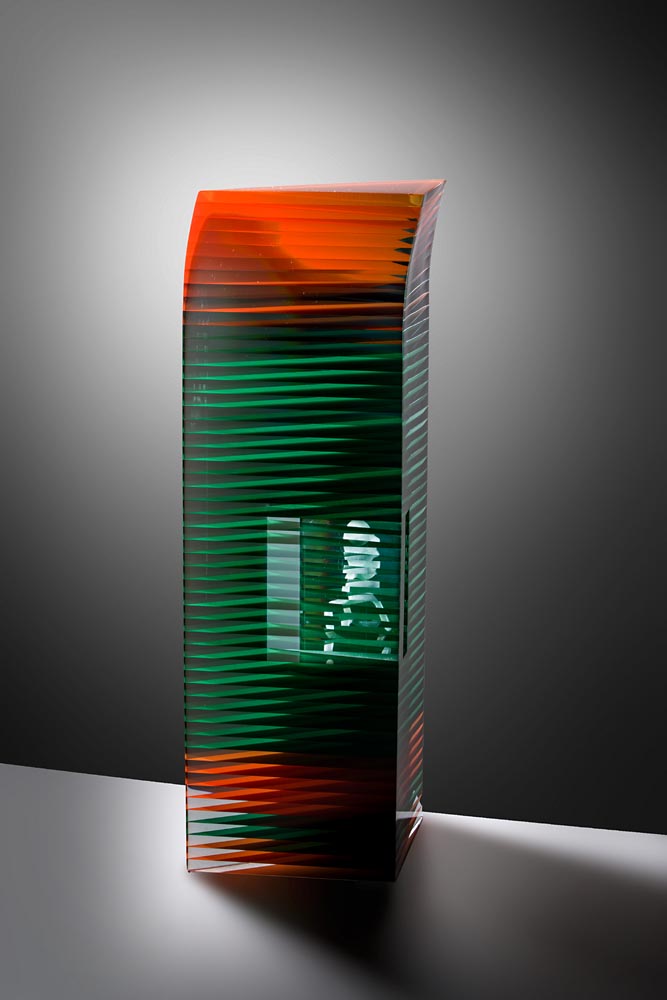
Inhabitant created in 2002, belongs to a group of works in which Bohumil Eliáš Sr. combines geometric structure, painted colour and layered glass into a compact spatial whole. The strict vertical form contains an optically shifting image that breaks apart, multiplies and reassembles as the viewing angle changes. The work thus appears as an enclosed microcosm – an architecture that truly seems to contain someone or something within it.
At first glance, Inhabitant has an almost architectural presence. The tall, compact prism is defined by a clear vertical structure, while its regular horizontal divisions evoke a building model, a container or a precisely constructed space. Only on closer inspection does it become apparent that its interior is neither fixed nor unambiguous. Individual layers of glass, coloured planes and small pictorial elements begin to overlap, creating a constantly shifting optical landscape.
It is precisely this contrast between external stability and internal variability that is fundamental to the work. While the outline of the sculpture appears strict and rational, a far more complex situation unfolds within the glass mass. Colour, light, reflection and the individual layers alter the apparent depth of the object, creating the impression of a space that extends beyond its actual physical dimensions.
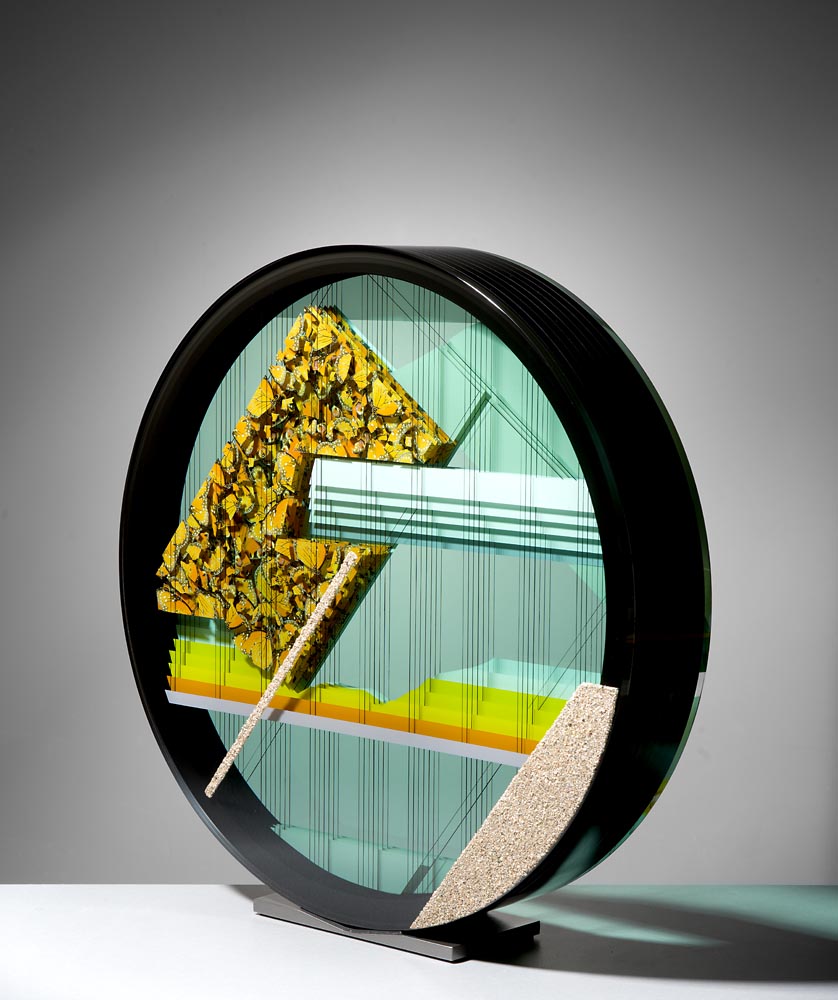
Here, Eliáš uses layered glass as a means of creating a genuinely spatial image. The individual sheets are not merely joined together mechanically; each contributes to the final optical construction. Lines, bands of colour and small internal elements shift in relation to one another depending on the viewing angle, creating new configurations. What appears from the front as a continuous image breaks down into separate planes as the viewer moves around the work.
This principle is one of the most characteristic features of Bohumil Eliáš Sr.’s work. Glass allowed him to move beyond the limitations of traditional painting. The image was no longer bound to a single plane, but could be divided across several transparent layers. As a result, the viewer perceives not only the motif itself, but also the actual space between the individual parts of the composition.
Colour plays a prominent role. Deep greens and darker tones form the foundation of the sculpture, into which intense orange-red areas enter. These appear mainly in the upper and lower sections of the object and act as strong visual accents. Their warm colour contrasts with the cooler greens, giving the composition an inner tension.
Colour, however, is not merely decorative. Together with the transparency and density of the individual layers, it determines how deeply the viewer’s gaze can penetrate the object. In some areas, the glass opens up and reveals the internal structure; in others, the layers become optically denser and the space closes in.
At the centre of the composition, a small light form appears, which can be perceived as a figure, a sign or simply a presence. It is here that the title Inhabitant begins to function as an important interpretive key. The sculpture no longer appears merely as an abstract construction, but as a space that seems to be inhabited by something.
There is no need to search for a specific human figure. The “inhabitant” may equally be understood as a symbol of presence, consciousness or life within a structure that at first appears cold and rational. Eliáš creates a tension between architecture and organism, between the construction itself and whatever seems to be taking place within it.
The theme of space and inhabitation takes on an almost philosophical dimension in this work. The object may evoke a house, a city, a technological shell or a model of an unknown environment. In every case, there is a sense that the external geometry conceals a more complex inner world.
The polished edges and precise craftsmanship further emphasise this architectural character. Light refracts sharply along the edges, creating a contrast with the softer optical effects within the sculpture. The edges therefore act as clear boundaries of the object, while its interior remains shifting and ambiguous.
In an interior, Inhabitant benefits above all from high-quality lighting. Its vertical proportions make it particularly well suited to an independent plinth, a console, or a setting where it can be viewed from several sides. Side and back lighting can significantly enhance the individual layers and create a stronger optical effect.
This is the kind of work that can function equally well in a minimalist setting. Its form is sufficiently clean and restrained, yet at the same time it offers a wealth of detail and visual transformation. From a distance, it appears as a clearly defined coloured object; viewed up close, it opens into a complex spatial composition.
For collectors, Inhabitant is a highly representative example of Bohumil Eliáš Sr.’s late work. Created in 2002, it comes from a period when the artist had already accumulated several decades of experience in painting, architecture and glass, allowing him to bring these approaches together in highly concentrated sculptural forms.
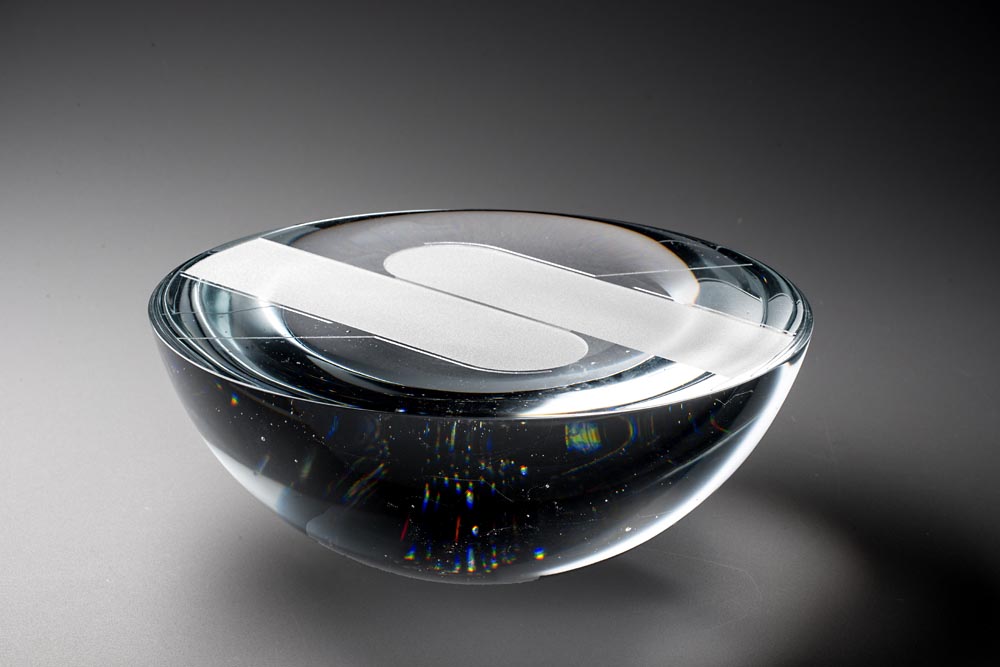
Within the context of the exhibition Two paths, one name, it is particularly interesting to compare this work Inhabitant with the piece of the same title by Bohumil Eliáš Jr. from 2020. The shared title is fascinating precisely because the two artists approach the theme in completely different ways. In the senior artist’s work, the “inhabitant” is concealed within the layered architecture of the glass. In the junior artist’s work, by contrast, the inhabitant may become the viewer themselves, whose image is reflected on the dark surface of the sculpture.
It is precisely moments like these that give the exhibition its meaning. The aim is not simply to search for similarities between father and son, but to observe how certain motifs, questions and artistic principles can reappear across generations and lead, each time, to a completely different result.
More about the artist >>> here <<<