Description
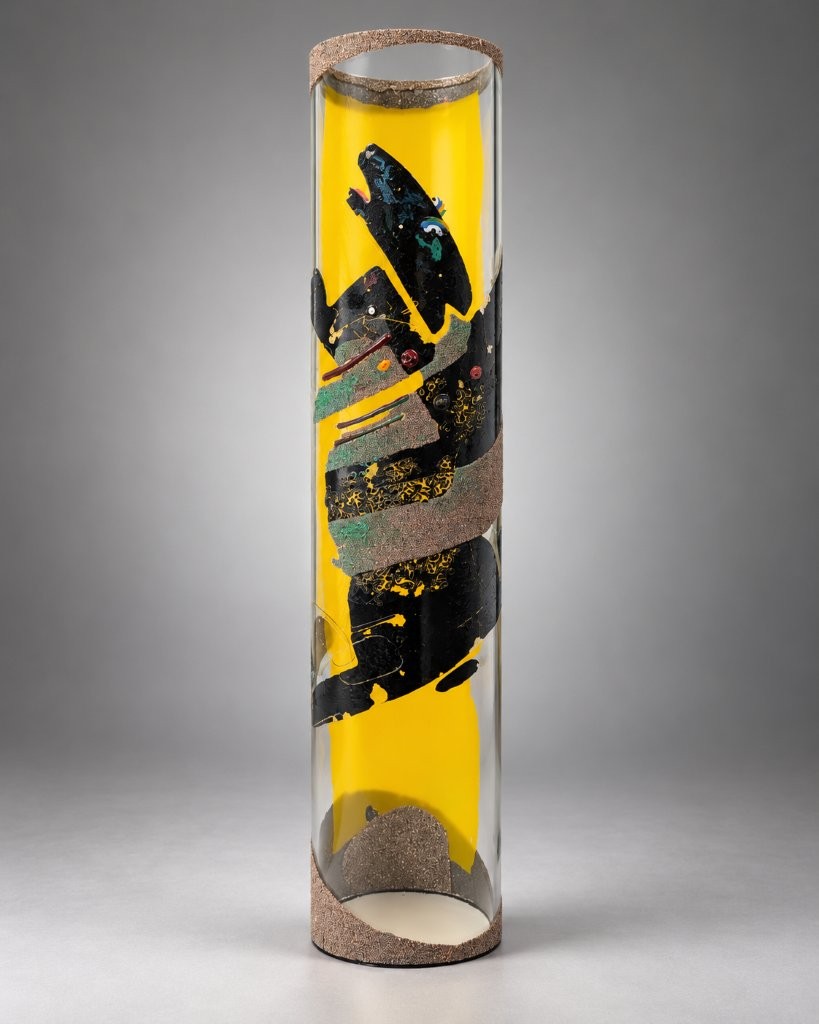
Bohumil Eliáš st., Zvíře, 1996
The tall cylindrical object by Bohumil Eliáš Sr. combines transparent glass with a striking yellow pictorial field and a stylised motif of a dog. The work functions simultaneously as a sculpture, a transparent image and a spatial vessel in which painting, light and the motif itself shift according to the viewing angle.
This tall cylindrical object belongs to a group of works in which two essential aspects of Bohumil Eliáš Sr.’s practice are brought together with particular clarity: painterly thinking and the use of glass as a spatial medium. Unlike a conventional painting, the painted image does not unfold on a flat, enclosed surface. Instead, it wraps around a transparent cylindrical volume, and thanks to its curvature, the individual parts of the composition continuously overlap, disappear and re-emerge as the viewer moves around it.
The first thing that draws attention in the work is the intense yellow. It functions as a vivid field of colour that illuminates much of the composition and creates a strong tension with the dark black and grey interventions. Yellow is not merely a backdrop here. It is an active part of the image – shaping its rhythm, allowing light to pass through and at the same time enabling the darker forms to project almost into the foreground.
The relationship between light and colour is fundamental to the entire object. The transparent glass cylinder captures the surrounding light and carries it across its curved surface. As a result, the colour does not appear uniform across the object’s full height and circumference. In one area it may seem saturated and compact, while elsewhere it becomes lighter, allows the surrounding space to show through, or optically overlaps with the painting on the opposite side.
The work therefore has no single definitive appearance. From the front, one group of forms may dominate, but as the viewer moves around the object, their relationships gradually shift. The black and coloured forms move in relation to one another, certain parts of the motif connect with those on the opposite side of the cylinder, and the entire image acquires a new spatial layer.
At the centre of this pictorial structure, a stylised motif of a dog emerges. It is not rendered realistically or descriptively. The figure breaks apart into black, grey, green and other coloured areas, and at times almost disappears into the abstract structure. The viewer can recognise it, but it never becomes a simple illustrative motif.
Právě tento způsob práce je pro Eliáše typický. Konkrétní motiv není cílem sám o sobě. Pes se stává součástí širší obrazové struktury, v níž se figurace propojuje s abstrakcí, gestem, barvou a prostorem. Jednou vystupuje z kompozice zřetelněji, jindy se znovu rozpouští v malířských vrstvách a světelných odrazech.
The curved form of the glass intensifies this effect even further. The painting no longer behaves like an image on a flat surface, but rather as an image stretched across space. The motif of the dog therefore cannot be grasped from a single viewpoint. The viewer has to move around the work and gradually piece its individual elements together. What is legible from one angle may disappear from another, or merge with additional layers of the composition.
This principle moves the work decisively beyond conventional painting and into the realm of a true spatial object. Glass is not merely a support for the image here. It becomes an active medium that determines how the image transforms, how light enters into it and how the viewer experiences it in space.
The material textures along the upper and lower edges of the object also play an important role. Their rougher, granular surface creates a contrast with the smooth transparency of the glass and visually frames the entire cylinder. This reinforces both its physical presence and its strong vertical character.
It is precisely this verticality that gives the object an almost architectural or totemic presence. The work appears as a column, a vessel or an independent sign within the space. Although narrow, its height gives it a strong sense of authority and creates a clear vertical accent.
In an interior, the object can function as a powerful solitary piece. Ideally, it should be placed where it can be viewed from several sides and where sufficient visual space remains around it. With a work of this kind, it would be a missed opportunity to position it too close to a wall, as moving around the object is essential to fully understanding the relationship between painting and transparency.
The work responds particularly well to daylight, especially when placed near a window or in a space with changing light conditions. The yellow becomes more luminous, the transparent areas open up, and the darker sections create a stronger contrast. Under evening gallery lighting, by contrast, the work can take on a more dramatic and concentrated presence.
Pro sběratele je dílo zajímavé tím, že velmi přesvědčivě spojuje Eliášovu malířskou a sklářskou zkušenost. Je zde figurativní motiv, výrazná práce s barvou, prostorové uvažování i schopnost využít transparentnost materiálu k proměně obrazu. Ani jedna z těchto složek není druhé podřízená.
Within the context of this exhibition Two paths, one name, this object also plays an important role because it presents Bohumil Eliáš Sr. at a moment when his identity as a painter comes very strongly to the fore. Alongside the layered Inhabitant, geometrically structured objects and more construction-oriented sculptures, it represents a different approach to glass – one in which the image remains highly present, yet at the same time is liberated from the flat surface. Obyvatele, geometricky členěných objektů nebo konstrukčnějších plastik představuje jinou cestu práce se sklem – cestu, kde je obraz stále velmi přítomný, ale zároveň se osvobozuje od rovné plochy.
It is precisely here that the strength of the work lies. The motif of the dog remains recognisable, yet it is never confined to a single interpretation. It changes with the light, the viewing angle and the surrounding space. Rather than imposing a fixed frame, glass gives the motif an additional dimension.
The result is an image that cannot be fully read from a single viewpoint. The viewer needs to move around it, observe how the individual layers come together and separate again, and allow the motif to gradually emerge from the surrounding space. In this way, the work touches very precisely on the essence of Eliáš’s approach to glass – his effort to move the image beyond the flat plane and into real space.
More about the artist >>> here <<<