Description
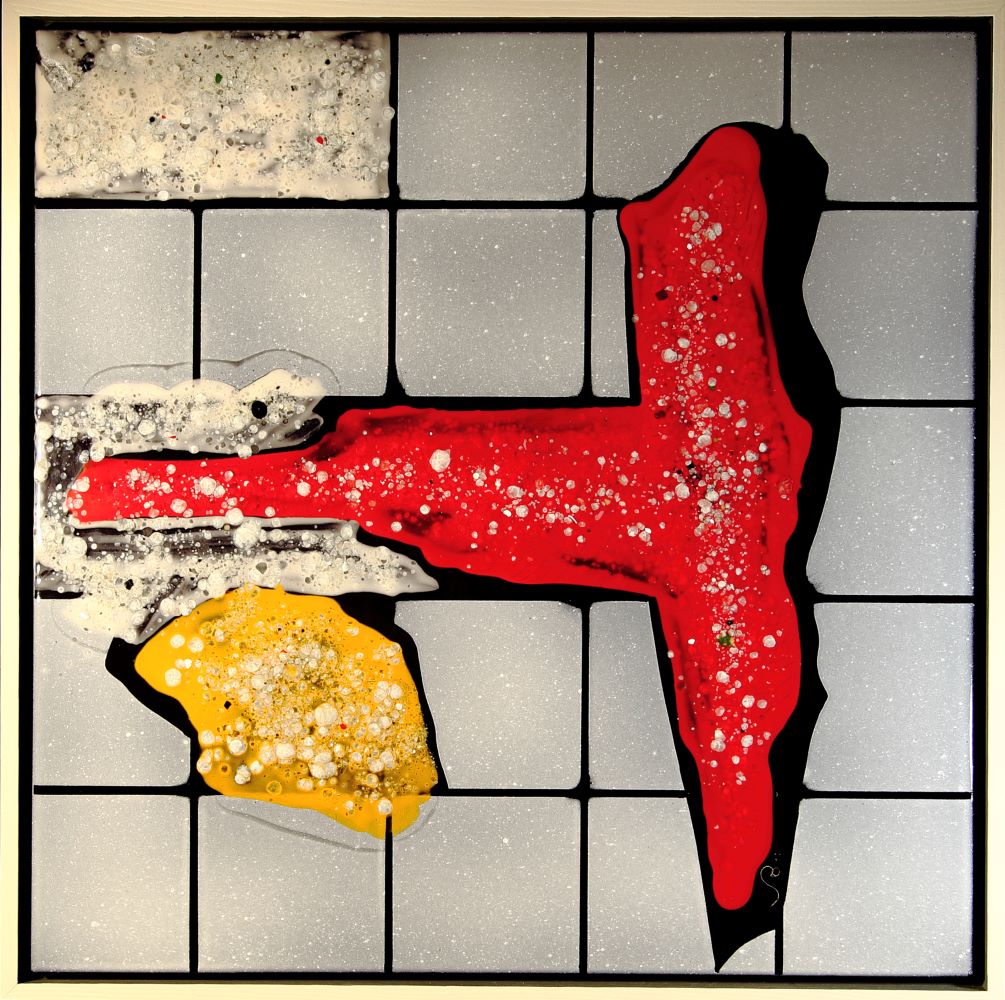
Bohumil Eliáš Jr., The Dominance of Red, 2025
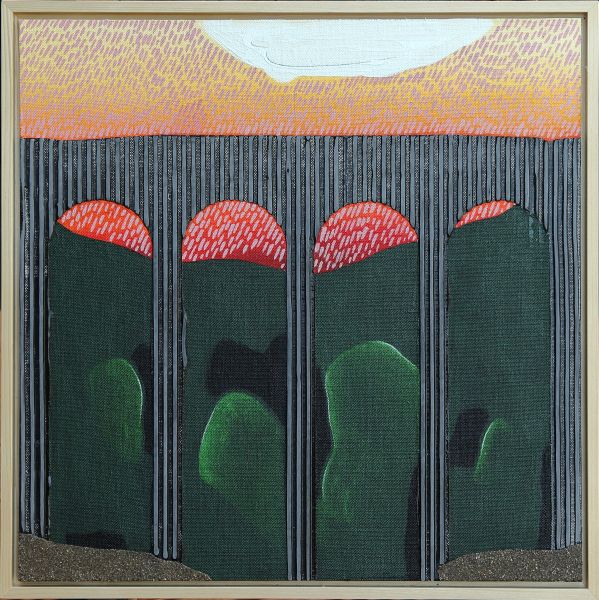
The Dominance of Red is an intimate work by Bohumil Eliáš Jr. in which a precisely organised geometric structure collides with vivid, organically shaped fields of colour. A regular black grid establishes a stable system into which a dominant red form enters, accompanied by white, yellow and black elements. The tension between order and spontaneity, construction and gesture, is one of the central themes of the work.
The composition is built on a regular network of black lines dividing the pale surface into individual fields. The grid has an almost architectural quality – it may evoke a plan, a structural diagram, a network or a model of space. It establishes a firm order against which the other elements can assert themselves.
Into this precise structure enters the dominant red form. Extending both horizontally and vertically, it immediately attracts the eye through the intensity of its colour. Yet its shape is not geometrically pure. Its outline is irregular and organic, as though the material had developed through spontaneous movement, growth or flow.
This is where the title The Dominance of Red becomes particularly meaningful. Red genuinely controls the composition, but not simply because of its scale. It determines the emotional tension of the image, establishes its principal direction and becomes its strongest visual element. The other colours respond to it, balance it or intensify its effect.
The surface of the red form is animated by numerous pale traces and irregular textures. As a result, the enamel does not appear as a uniform, smooth field, but acquires an almost tactile, material quality. Small bubbles, marks and textures may evoke sediment, a microscopic image or traces of a chemical process.
On the left side of the composition, a pale form creates another relationship with the dominant red element. Its softer colouring and irregular surface provide a counterpoint to the red mass. It may suggest a trace, fragment or another stage of the same material process.
A strong yellow area appears below. Although smaller in scale, its intensity gives it an important role within the composition. It creates another chromatic centre and prevents the image from being completely controlled by a single colour. Yellow therefore acts as a counterweight to red without ever challenging its dominance.
The relationship between the coloured forms and the black grid is equally important. The black lines stabilise the composition and provide a clear framework against which the colours can assert themselves. At the same time, the organic forms disrupt this regularity and in places almost overwhelm it.
This collision between a fixed system and its disruption is one of the painting’s strongest qualities. The grid represents control, construction and order, while the enamelled colour forms appear lively, irregular and spontaneous. The work oscillates between these two principles without allowing either one to become absolute.
This is particularly interesting in relation to the title. Although The Dominance of Red clearly identifies the principal chromatic force, the composition is in fact based on a carefully balanced relationship between all its elements. Red dominates, but it requires the black grid, pale background and yellow accent in order to fully reveal its power.
Enamel also gives the colours a distinctive intensity and surface quality. Colour does not function merely as a painted mark, but almost as an independent material. Some areas appear liquid, others solidified or crystalline, giving the work a pronounced physical dimension.
In this respect, a connection can also be made with Bohumil Eliáš Jr.’s sculptural and glass-based practice. Even in a two-dimensional work, he approaches material in a highly physical way. This is not simply a colour composition, but an exploration of structure, surface and matter.
In an interior, The Dominance of Red can function as a strong colour accent. Its 50 × 50 cm format is intimate, yet the intensity of the red and the clarity of the geometric structure give it considerable visual presence. It can work particularly well in a minimalist environment, a study, a modern residential interior or as part of a larger collection.
The intense red responds beautifully to neutral walls, concrete, wood, black metal or pale natural materials. The work has enough energy to activate a space while retaining a sense of visual discipline through its regular grid.
From a collector’s perspective, the date of 2025 is also significant. This is a contemporary work by Bohumil Eliáš Jr. that reveals another strand of his practice beyond glass sculpture. Yet the themes that recur throughout his work remain present – construction, layering, the relationship between organic and geometric forms, and the use of material as an active part of the image.
Within the context of the exhibition Two paths, one name, The Dominance of Red demonstrates that Bohumil Eliáš Jr.’s painting is closely connected to his spatial work. Here too, he treats the image as a system in which structure, material, colour and empty space are set against one another.
The strength of the work lies precisely in this balance. Red may dominate, but the image is not simply about colour. It is above all about the relationship between control and spontaneity, geometry and matter, rule and disruption. This is what allows a relatively simple composition to sustain such tension and visual energy.