Description
Bohumil Eliáš ml., Inhabitant, 2026
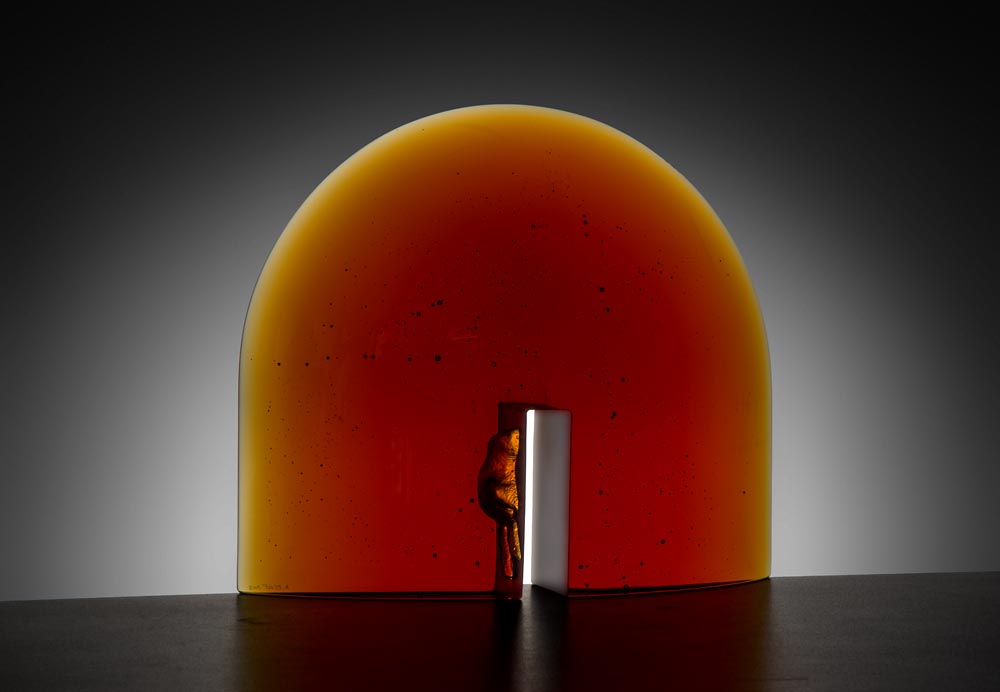
Inhabitant is an intimate glass sculpture in which Bohumil Eliáš Jr. brings together a simple architectural form, intense colour and a small figurative motif. The monumental-looking red-orange volume resembles a shelter, a house or an enclosed space entered through a single narrow opening. Within it appears a figure – small in relation to the surrounding mass, yet fundamental to the meaning of the entire work.
At first glance, the object appears remarkably simple. Its basic form is compact and almost archetypal: a rounded mass rises from a flat base, with a narrow vertical entrance cut into its centre. This reduced geometry recalls architecture stripped of all unnecessary detail – an elemental idea of shelter, home or a space separating an interior from the outside world.
It is precisely this simplicity that allows the relationship between solid mass and empty space to become so powerful. The opening at the centre is not merely a technical feature. It functions as a genuine entrance into the object and at the same time as a strong negative form that interrupts the solidity of the sculpture. It draws the eye and directs it inward.
Inside, a small figure appears. Its presence radically alters the way the sculpture is read. Without it, the object might be understood as a purely abstract composition based on colour, form and light. The figure, however, immediately introduces scale, narrative and the idea of a space that is genuinely inhabited.
The title Inhabitant therefore functions not merely as a poetic designation, but as an important interpretive key. The object begins to resemble a small world of its own. It might be a house, a sanctuary, a shelter or an entirely unknown form of architecture. Eliáš offers no definitive explanation, leaving the ambiguity of the situation open to the viewer’s imagination.
Colour plays a particularly prominent role. Rich red shifts towards warmer orange and amber tones along the edges. Yet because of the transparency and thickness of the fused glass, the colour never appears as a uniform surface. It exists within the material itself, changing according to thickness, illumination and viewing angle, and giving the sculpture an unusual internal glow.
Under changing light, the object transforms significantly. Thicker areas appear darker and denser, while the edges can become almost luminous with an amber glow. The glass creates the impression that the object is not simply illuminated from outside, but carries light within itself.
This effect is intensified by the contrast between the monumental coloured mass and the narrow, darker entrance. The viewer’s gaze is almost automatically directed towards this opening. The small figure therefore becomes both the optical and conceptual centre of the entire composition, despite occupying only a very small part of the object physically.
The relationship of scale is equally compelling. The sculpture itself is intimate in size, yet the presence of the tiny figure allows it to be perceived as a much larger architectural structure. What measures only a few dozen centimetres in reality can expand in the viewer’s imagination to the scale of a building. Through a remarkably simple device, Eliáš transforms our perception of the space contained within the object.
In an interior, Inhabitant can function as a strong solitary piece despite its relatively modest dimensions. Its intense colour means that it requires little competition from other visually dominant elements. It works particularly well on a freestanding plinth, a console, or in a setting where it can respond to natural or carefully directed side lighting.
It can be especially effective in a minimalist interior or in combination with natural and neutral materials such as stone, wood, concrete or metal. Its warm red-orange colour can provide a powerful visual accent, while the simplicity of its silhouette preserves the overall clarity of the surrounding space.
From a collector’s perspective, the date of 2026 is also significant. This is a current work by Bohumil Eliáš Jr., demonstrating his continued exploration of space, architecture and the relationship between glass and the human figure. Despite its highly reduced form, the result is not a cold geometric object. The presence of the figure gives the sculpture a human dimension and a strong narrative quality.
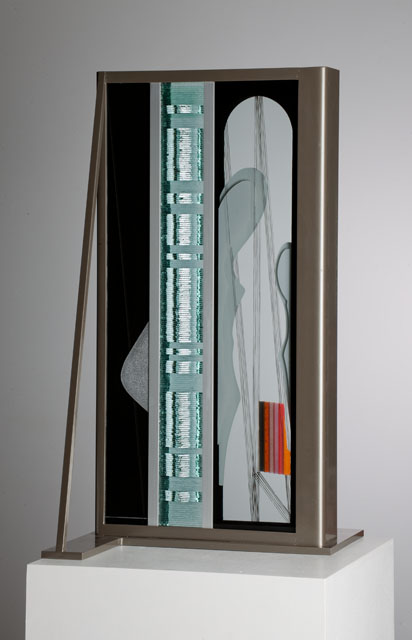
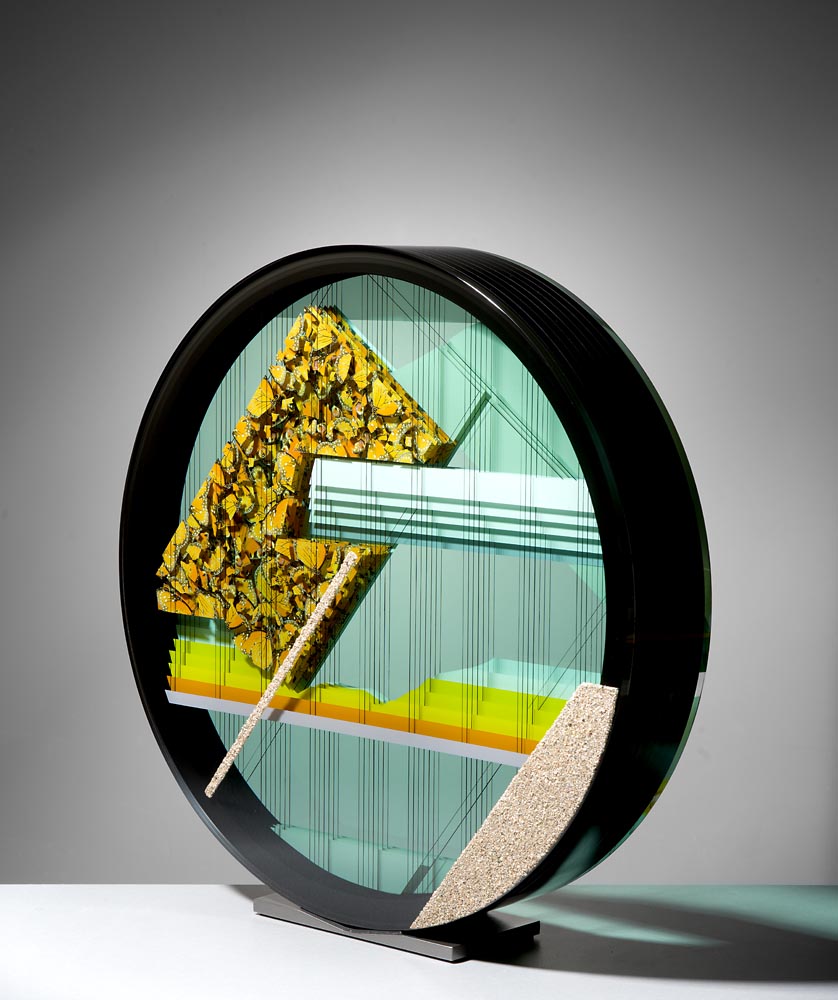
Within the context of the exhibition Two paths, one name, má Inhabitant acquires an additional layer of meaning. Themes of inhabitation, interior space and presence also appear in the work of Bohumil Eliáš Sr., yet each artist approaches them differently. In the senior artist’s work, the “inhabitant” may be concealed within the layered architecture of glass, whereas here Bohumil Eliáš Jr. makes that presence more concrete through a small figure placed within a clearly defined architectural form.
Such parallels reveal the true purpose of the exhibition. The aim is not to search for direct quotations or to prove similarities between father and son. Far more interesting is to observe how certain questions – space, presence, architecture, light, or even the idea of an “inhabitant” itself – reappear across two generations and lead each time to a different result.
Inhabitant is therefore a seemingly simple yet highly concentrated work. A compact coloured mass, a single opening and a small figure are enough to create an entire imaginary space. Its greatest strength lies precisely in this tension between a physically small object and the much larger world it is capable of creating in the viewer’s imagination.
More about the artist >>> here <<<