Description
Bohumil Eliáš Sr., Give me Peace, 1998
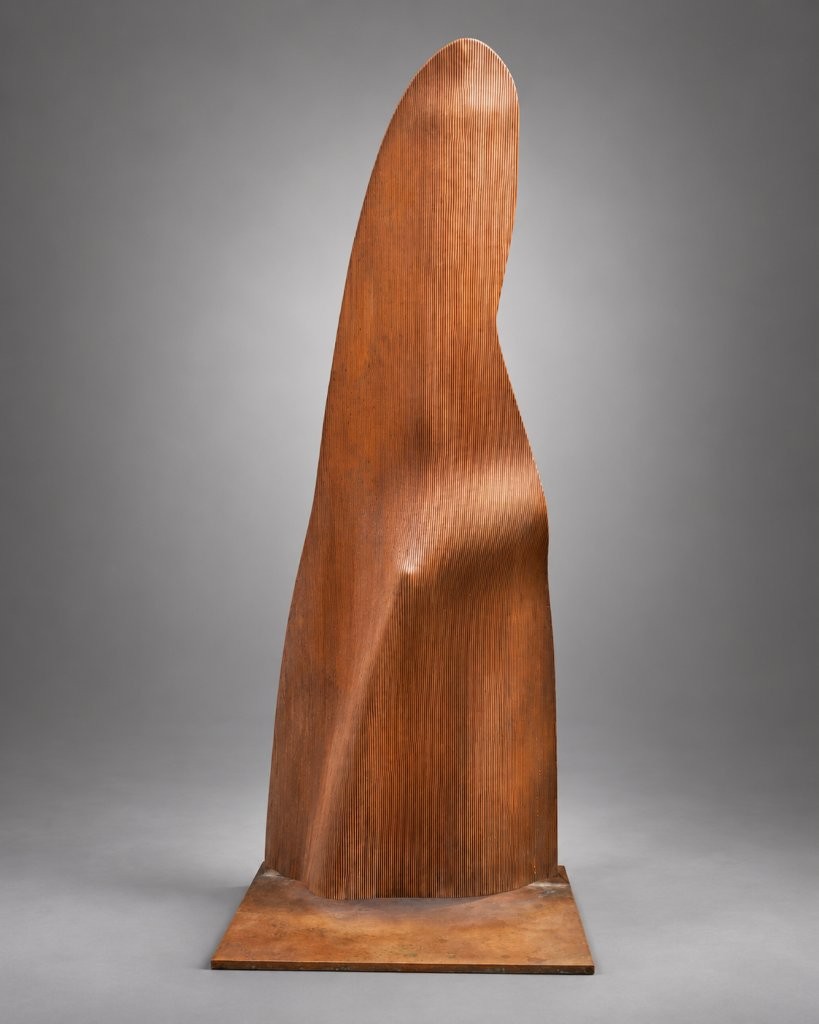
Give Me Peace is a striking bronze sculpture in which Bohumil Eliáš Sr. moves away from the transparency of glass and works instead with solid mass, surface and silhouette. The elongated vertical form appears both organic and monumental. Fine longitudinal ribbing emphasises the movement of the surface, while the asymmetrical silhouette creates a sense of calm, tension and a certain inward withdrawal. The work reveals the artist in a less familiar, yet particularly compelling sculptural mode.
At first glance, Give Me Peace appears as a very simple vertical form. Its true strength, however, emerges only through prolonged viewing. The shape is neither geometrically precise nor entirely regular. It narrows towards the top, gently shifts off axis, and its outline changes continuously. The sculpture may therefore evoke a body, a cloak, a fragment of a natural formation, or a completely abstract sign.
This ambiguity is fundamental to the work. Eliáš does not offer a clearly defined figure, yet the sculpture has a strong bodily presence. Its vertical proportions naturally evoke the human scale, while the way the mass expands and contracts in different areas can suggest the movement of a body concealed beneath the surface.
The title Give Me Peace reinforces this association. It introduces a human and psychological dimension into an otherwise abstract sculpture. The object may appear like a figure turning inward, withdrawing from the surrounding world, or creating its own protective space. Yet it is not an illustration of a specific situation. The title instead opens up a way of perceiving the work – as an image of the need for silence, distance and inner space.
The surface of the sculpture plays a particularly important role. Fine vertical ribbing covers almost the entire form, creating a regular rhythm that contrasts with the organic irregularity of the silhouette itself. These lines also emphasise the verticality of the work and guide the viewer’s gaze upwards.
The ribbed surface responds strongly to light. The individual lines create subtle transitions between light and shadow, preventing the bronze from appearing as a uniform mass. As the angle of illumination changes, some areas brighten while others darken, giving the surface an almost mobile quality.
This is especially interesting because the material itself is physically solid and heavy. Through the shape and surface structure, however, Eliáš visually lightens this weight. The sculpture does not feel static. On the contrary, it can suggest a form that is slowly stretching, turning, or changing according to the position from which it is viewed.
Bronze also functions here very differently from the glass with which Bohumil Eliáš Sr. is most often associated. Glass allows for transparency, layering and the movement of light within the material. Bronze, by contrast, is opaque and physically closed. As a result, the outer surface, silhouette and the way light moves across the object become all the more important.
This contrast reveals the breadth of Eliáš’s artistic thinking. Although he is working with a different material, several of his core principles remain. The relationship between light and surface, and between a clearly defined form and its changing appearance when viewed from different angles, remains essential.
In an interior, Give Me Peace can function as a powerful solitary piece. At one metre in height, it has a strong physical presence even in a representative space, without requiring monumental architecture around it. Ideally, it should be placed where the object can be viewed from several sides and where sufficient open space remains around it.
It works particularly well in a minimalist interior, where the clarity of its silhouette can fully emerge, but it can be equally convincing alongside natural materials such as stone, wood or concrete. The warm tone of the bronze also creates an interesting contrast with the cooler surfaces of modern architecture.
The work responds strongly to directional side lighting, which emphasises the ribbed structure and modelling of the surface. Softer, diffused light, on the other hand, highlights the overall silhouette and the calmer character of the object. The emotional effect of the sculpture can therefore shift significantly depending on the lighting.
From a collector’s perspective, the date of 1998 is also important. The work was created during Bohumil Eliáš Sr.’s mature period, at a time when he already had extensive experience in painting, glass, architecture and spatial work. The bronze sculpture therefore does not feel like a departure from his main practice, but rather as another way of exploring questions of form, space and light.
Within the context of the exhibition Two paths, one name, je Give Me Peace is also significant because it broadens the understanding of Bohumil Eliáš Sr.’s work beyond glass. It demonstrates that his artistic thinking was never bound to a single material. What remained central was the relationship between the human presence, the object and the surrounding space.
This is precisely why the sculpture still feels highly contemporary today. Its form is reduced, but not cold. Its surface is regular, yet its silhouette remains organic. And the title gives the object an emotional dimension without imposing a single interpretation on the viewer.
Give Me Peace can therefore be read simultaneously in sculptural, formal and human terms. Its strength lies not in a wealth of detail, but in the carefully balanced relationship between mass, light, surface rhythm and a simple vertical gesture.
More about the artist >>> here <<<