Description
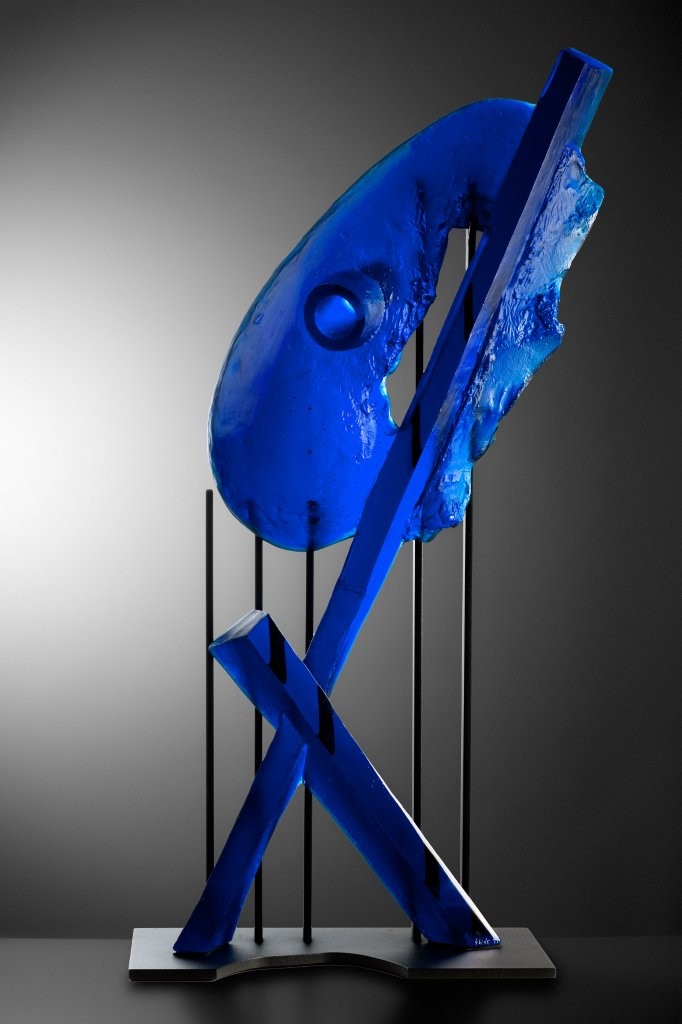
Bohumil Eliáš st., Modrý obyvatel, 1999
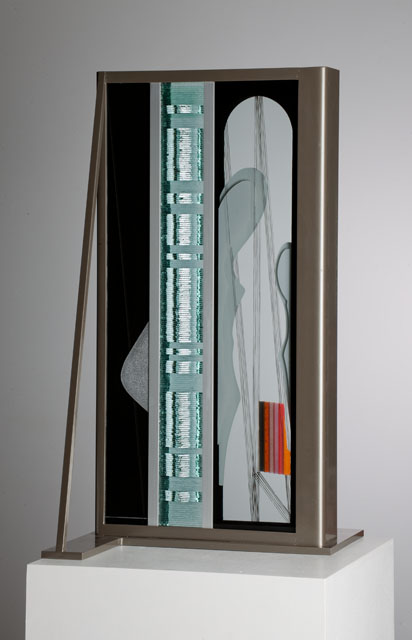
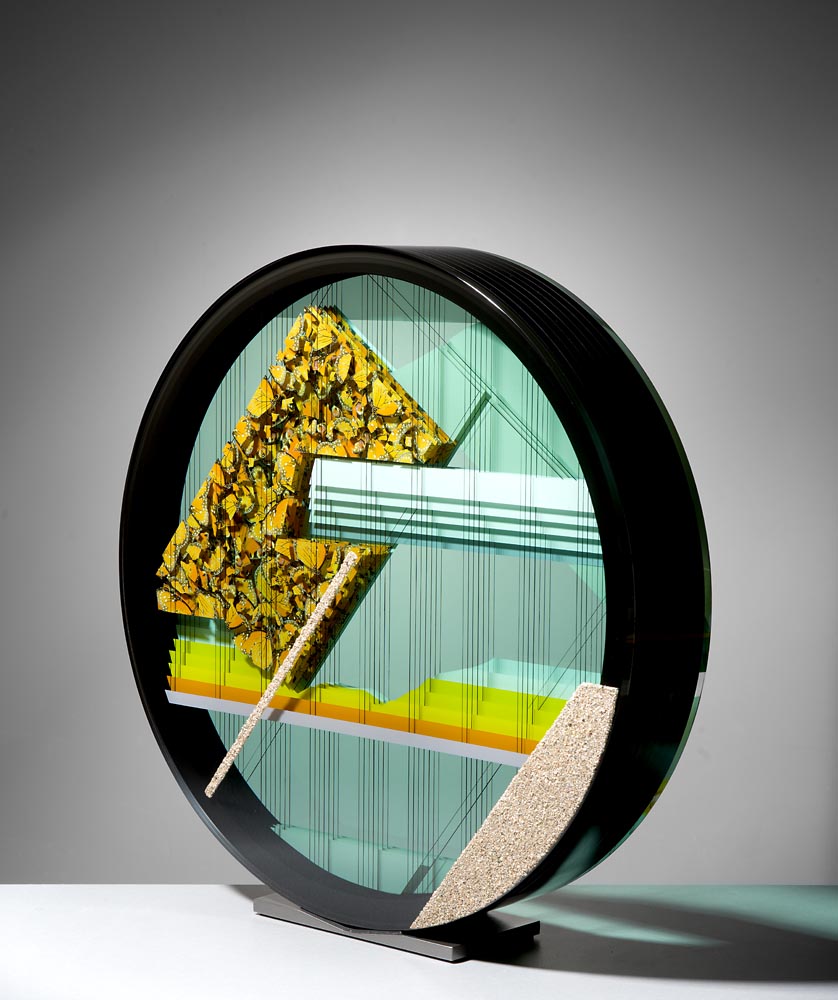
The Blue Inhabitant is places an organically modelled glass mass in direct contrast with a strict construction of lines, rods and diagonals. Rather than functioning as an isolated glass object, the work becomes a spatial situation in which free form, geometry, light and the physical presence of the material come into tension with one another.
At first glance, the work is defined by its intense blue colour. Rich, deep and almost electric, it never appears as a uniform surface thanks to the transparency of the glass. Light refracts through the material, passing through both its thicker and more delicate areas and creating a wide range of tones, from dark cobalt to brighter blue-violet hues.
It quickly becomes clear, however, that colour is not the work’s only expressive element. Bohumil Eliáš Sr. brings two contrasting worlds into direct dialogue: an organic, almost living glass form and a strict structural framework. The glass element appears spontaneous, irregular in places and almost biological in character. Its surface varies in density, thickness and texture, with certain passages evoking a bodily fragment, a shell, a cellular structure or a natural formation that seems to have emerged beyond human control.
Set against this organic quality is a system of diagonal and vertical elements. Straight lines enter the composition with an almost architectural precision. Some cut through the glass mass, while others support or visually frame it. The work thus gains an inner tension between what appears spontaneous and what is clearly structured and controlled.
This confrontation is fundamental to understanding the sculpture. Eliáš does not treat the structure merely as a technical support for the glass; it becomes an equal part of the artistic composition. The lines determine direction, rhythm and spatial relationships, creating a kind of open architecture around the glass mass.
The dominant diagonal is particularly important. It runs upward through the work from the lower section, creating a strong sense of movement. The viewer’s eye naturally follows this line before returning to the organic centre of the sculpture. The resulting composition is far from static; it feels almost like a process caught in motion, or the meeting point of several opposing forces.
The glass itself further enhances this dynamic. In some places, the material is almost transparent; in others, thanks to its greater thickness and texture, it transforms into a dense, coloured mass. The surface alternates between smooth and more irregular sections, creating very different reactions to light. One section reflects the light, another absorbs it, and yet another allows it to pass through.
Light is therefore an essential part of the work. Without it, the sculpture would appear far more compact. Illumination reveals the internal articulation of the glass, its subtle irregularities, the transitions between denser and more transparent areas, and the varying intensity of the blue tones.
The work can therefore change significantly depending on its surroundings. In daylight, its transparency becomes more pronounced and the glass mass appears lighter. Under directional gallery lighting, by contrast, the deep blue tones, surface textures and the contrast between the glass and its structural framework become more prominent.
In spatial terms, the sculpture is exceptionally active. It is not an object that can be fully understood from a single viewpoint. Both the structural framework and the organic form change depending on where the viewer stands. From the front, the overall composition and dominant diagonal come into focus; as one moves around the work, however, the individual elements overlap, separate and form new spatial relationships.
It is precisely this quality that brings the work close to sculptural thinking. The viewer is not a passive observer of a single pictorial plane, but must move around the object. The space between the individual elements is just as important as the material itself. Empty areas, openings and lines of sight are not absences of form, but active components of it.
In an interior, the sculpture needs above all sufficient space around it. It works best as a solitary piece on an independent plinth or in an open part of the room where it can be viewed from several angles. Thanks to its strong colour, it does not require a visually complex setting. On the contrary, it benefits from a calm environment in which the contrast between the blue glass mass and the dark structural framework can fully stand out.
The sculpture can work particularly well in a modern interior with clean architectural lines, but an equally compelling dialogue can emerge in spaces featuring natural materials such as stone or wood. The intense blue then becomes a powerful colour accent, while the structural elements of the sculpture can respond to and echo the lines of the surrounding architecture.
From a collector’s perspective, the work is compelling precisely because it goes beyond the traditional notion of a “glass sculpture.” It is a spatial construction in which glass enters into dialogue with other elements, revealing Eliáš’s long-standing interest in combining different artistic principles. Its significance therefore lies not only in the material beauty of glass, but in a much broader sculptural and spatial way of thinking.
Within the context of the exhibition Two paths, one name, this work is also important because it broadens the understanding of Bohumil Eliáš Sr. beyond his better-known work with layered and painted sheet glass. It shows that his practice could also be distinctly sculptural, constructive and physically assertive.
It is here that the artist’s ability to move between painting, glass, object and architecture becomes especially clear. The organic mass does not become an isolated sculpture, nor is the structure merely a support. The two depend on one another and together form a single, tension-filled whole.
skrývá její největší vizuální síla. The result is a sculpture that feels spontaneous yet precise, substantial yet transparent, organic yet technical. It is precisely within these contrasts that its greatest visual power resides.
More about the artist >>> here <<<