Description
Bohumil Eliáš Jr., Inhabitant, 2020
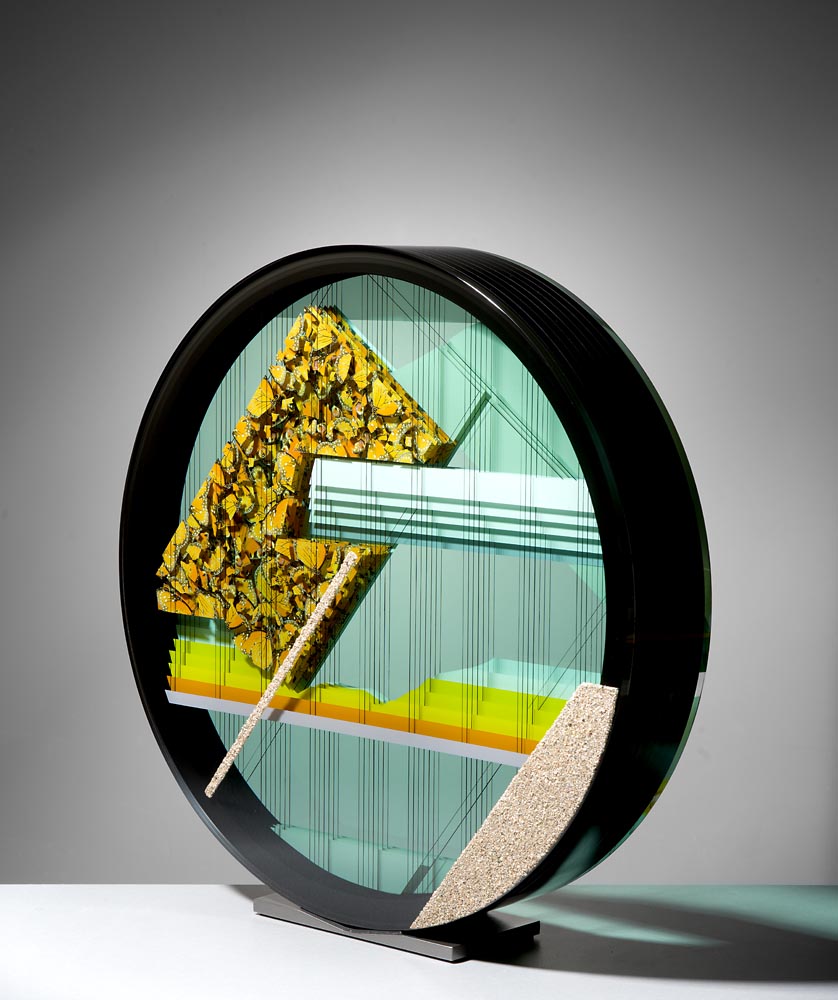
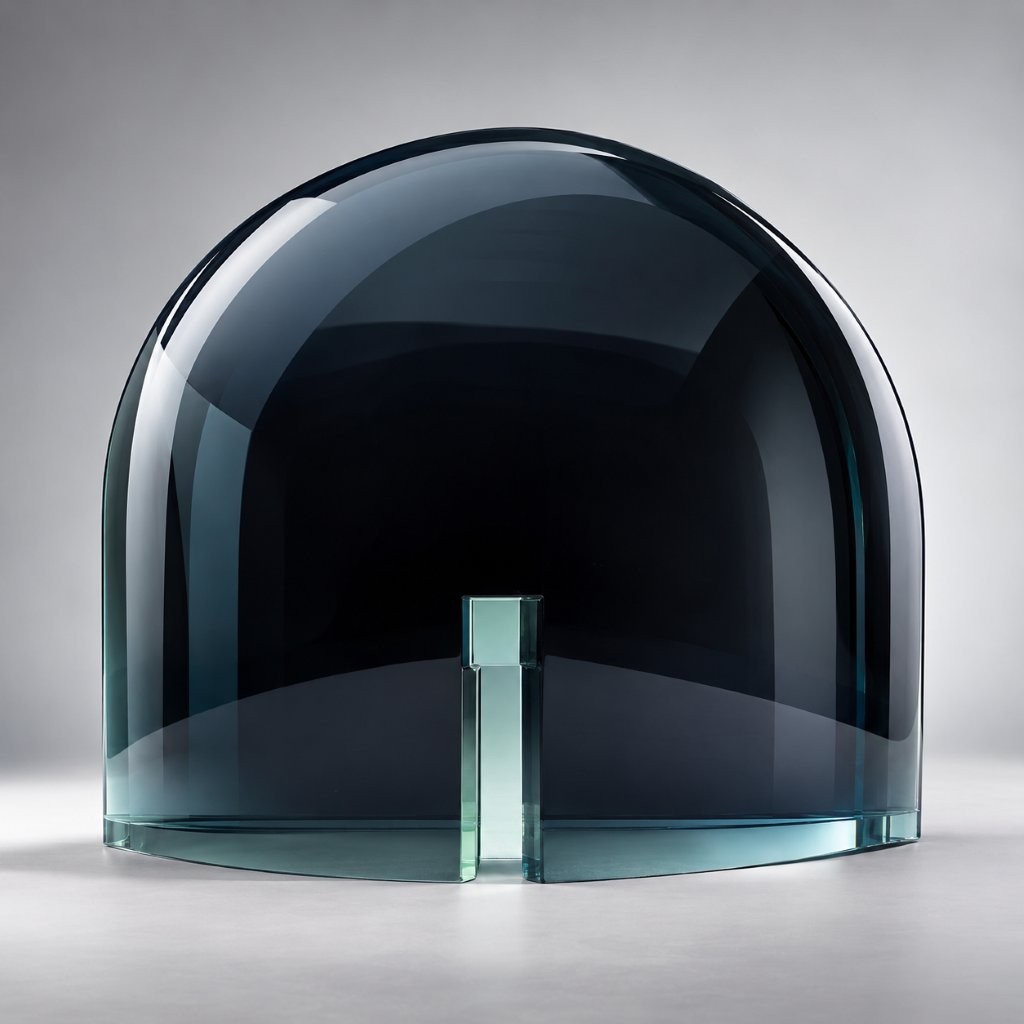
The monumental dark object Inhabitant explores one of the most compelling paradoxes of glass: a material usually associated with transparency and light is transformed here into an almost impenetrable, reflective mass. Its surface captures the surrounding space as well as the viewer, giving the title Inhabitant a surprisingly literal dimension – for a brief moment, anyone standing in front of the work becomes part of it.
At first glance, Inhabitant appears almost as pure mass. Its dark, deep surface and simple rounded form give the object a distinctly sculptural monumentality, even though its dimensions remain relatively intimate. Only on closer inspection does its essential character begin to reveal itself: the surface is not closed. It receives light, interior space, movement and the person standing in front of it. The surrounding environment is distorted, multiplied and absorbed into the visual presence of the work itself.
This constant transformation is fundamental to Inhabitant. The object has no single definitive appearance. It behaves differently in daylight and at night, in an empty room and in a space filled with movement. Its dark surface acts almost like a black mirror, yet it does not return reality faithfully. The curvature of the glass compresses, stretches and translates the surrounding world into its own pictorial space.
The title Inhabitant therefore allows for several interpretations. It may suggest a being enclosed within the object, the presence of an unseen resident, or the sculpture itself as an autonomous body occupying space. At the same time, the viewer may become the inhabitant. The moment someone steps in front of the work, their reflection appears on its surface and, briefly, becomes part of the sculpture. The work is therefore not simply an object to be observed. It actively responds to the environment in which it is placed.
The technique of fused glass allows Bohumil Eliáš Jr. to approach the material in a way that is much closer to traditional sculptural thinking than to the conventional idea of a glass object. The material possesses weight, volume and a strong physical presence. The form is reduced and free of unnecessary decoration; the visual tension arises primarily from the contrast between the simplicity of the silhouette and the complexity of the reflections moving across its surface.
This is where Eliáš’s sculptural approach to glass becomes particularly clear. For him, the material is not merely a vehicle for colour or light. What matters is its physical presence in space – the relationship between object, architecture and viewer. Inhabitant therefore functions almost architecturally. Its rounded mass creates a strong visual centre and is capable of organising the space around it without relying on vivid colour or an elaborate form.
The dark glass also suppresses one of the qualities we automatically expect from the material – transparency. Instead of looking through the glass, we are forced to remain on its surface. Paradoxically, this opens the space in a different way: through reflection. The glass is no longer a window through which we look, but a surface that returns the world around us.
In an interior, Inhabitant benefits above all from sufficient space and carefully considered lighting. It can work particularly well as a solitary object on a low plinth, console or independent pedestal, where its rounded silhouette can be fully perceived. In a minimalist setting, it may appear almost meditative; in a richer interior, it begins to absorb colours, furniture and architectural details into its reflective surface. It is therefore not an object that merely “matches” an interior. The interior itself becomes an active part of its appearance.
For collectors, Inhabitant is also significant because it clearly represents one of the characteristic lines in the work of Bohumil Eliáš Jr.: an approach to glass as an autonomous sculptural material. This is not a decorative object based primarily on the visual appeal of glass, but an independent sculpture whose meaning emerges through its relationship with space and the viewer.
Within the context of the exhibition Two paths, one name, je Inhabitant is also a convincing example of Bohumil Eliáš Jr.’s independent artistic language. While his father’s work often employs layering, image, painting and transparency as ways of creating space within glass, here we encounter almost the opposite gesture: a compact, dark mass that does not open the space through transparency, but captures it on its surface.
And perhaps this is precisely where the greatest strength of ObyvateleAlthough the object appears almost closed, it is never truly alone. It always carries within it something of the place in which it stands – and of the people who approach it.
More about the artist >>> here <<<