Description
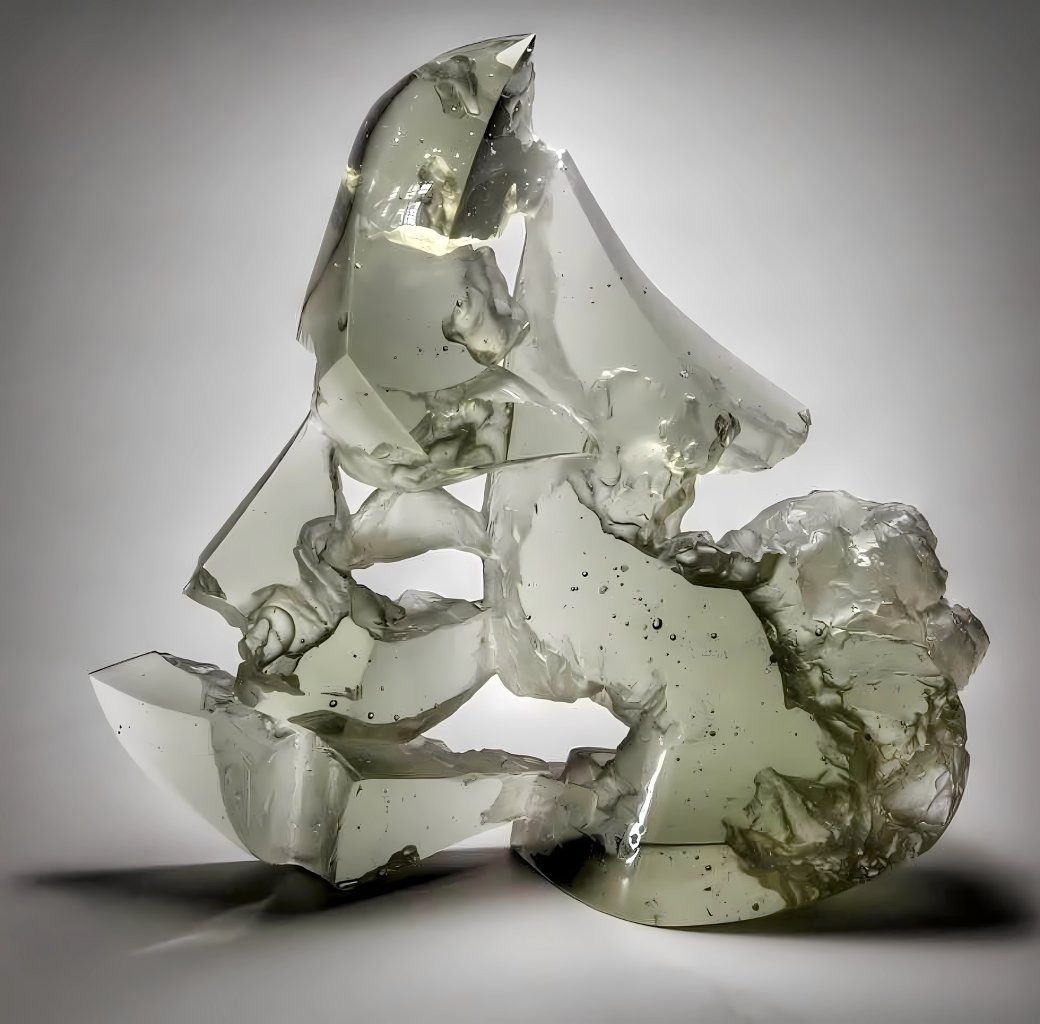
Sailing Ship, Petr Stacho, 2022
Petr Stacho’s Sailing Ship is a work whose title offers the viewer a certain key, but by no means provides a complete answer. The sailing ship is not depicted literally. We find no hull, mast or sails in a form that could be easily identified. Instead, we are confronted with a complex glass structure in which solid mass alternates with empty spaces, smooth surfaces with raw textures, and apparent stability with a sense of movement.
It is somewhere within this interplay that the sailing ship begins to emerge. Spend a little time with the sculpture and the upper section starts to rise into a pointed form that may suggest a sail caught by the wind. The individual diagonals imply forward motion, while the irregular lower section seems to dissolve into an imagined water surface. Yet this is by no means the only possible interpretation. One viewer may see a rock formation, another a fragment of architecture, and another still an abstract landscape.
Stacho leaves room for imagination. The title opens the door for us, but we have to walk through it ourselves.
The sculpture Sailing Ship was created using fused glass, followed by cutting, grinding and polishing. It is an object capable of asserting a strong presence within a space without relying on size alone to feel monumental. Its true monumentality is created primarily within.
At first glance, the transparent glass mass appears almost colourless. On closer inspection, however, it becomes clear how many different tones seemingly clear glass can produce. Smoky, grey-green and subtly yellowish hues emerge, along with delicate flashes of light. Here, colour is not applied to the surface. It arises from the optical behaviour of the material itself — its thickness, structure and the way light passes through it.
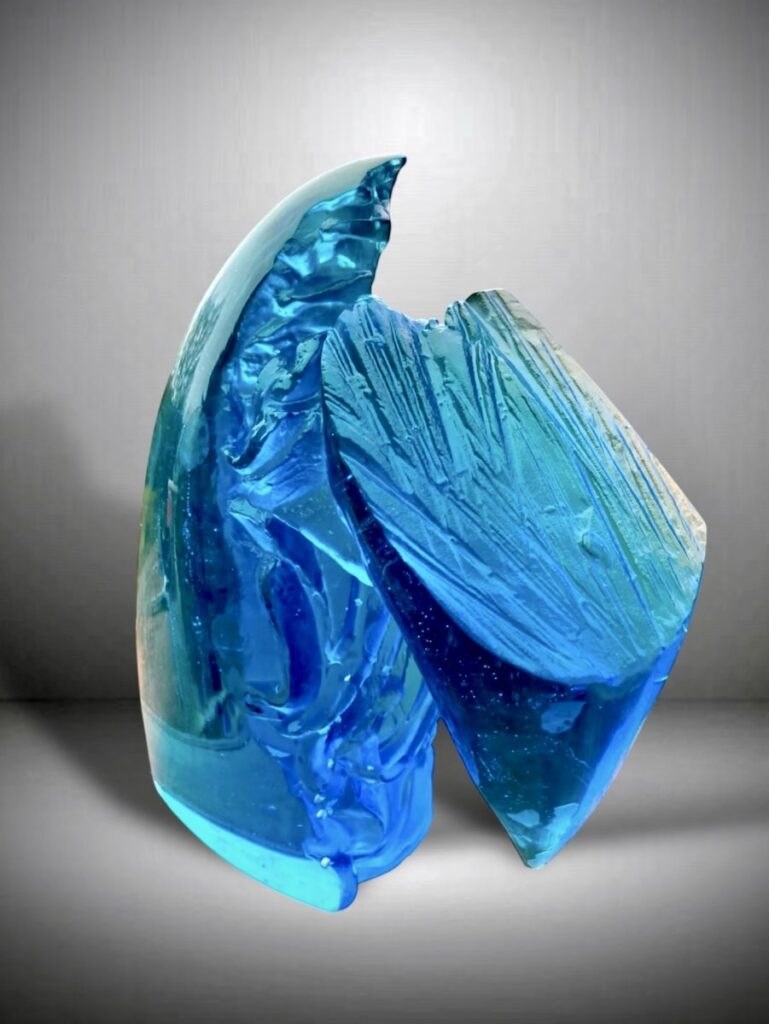
Particularly compelling is the contrast between the precisely finished and the irregular areas. Some surfaces are smooth, exact and perfectly polished, functioning almost like optical windows into the interior of the sculpture. Other sections, by contrast, retain a dramatic texture reminiscent of fractured stone, ice, eroded rock, or matter exposed to the force of some immense natural power.
The material feels heavy. Glass is physically solid and relatively substantial, yet the composition still creates a strong sense of movement. Diagonal lines rise, individual sections tilt, and openings between them visually lighten the object.
In Sailing Ship, light is an essential collaborator. It strikes the polished edges, penetrates deep into the glass mass, catches on irregular structures, and reveals tiny bubbles and traces left by the fusing process. Some areas allow light to pass through almost effortlessly, while others refract and concentrate it. What is especially interesting is that this allows the sculpture’s relatively restrained colour palette to feel highly dramatic. Stacho does not need strong pigments; he works primarily with the inherent capabilities of the glass itself.
With dimensions of 45 × 43 × 13 cm, the sculpture is well suited to function as a striking standalone piece in both private and representative interiors. It will work particularly well on a dedicated pedestal, console or low piece of furniture with sufficient distance from surrounding objects. Ideally, it should be possible to view the work from at least several angles, as each change in perspective reveals additional layers of the composition.
The work benefits from light coming from behind or from the side. In a minimalist interior, its almost sculptural monumentality can come fully to the fore, while in a setting that combines contemporary art with antiques, the transparent glass can create an intriguing contrast with materials such as wood, stone or metal.
For collectors of contemporary Czech glass, Sailing Ship is particularly compelling because it brings together several characteristics that are central to Stacho’s practice: his use of substantial masses of glass, the contrast between controlled finishing and raw structure, the incorporation of negative space, and his ability to transform a transparent material into a surprisingly sculptural composition.
It is also important that the object does not work from a single viewpoint alone. It has a genuinely sculptural character, encouraging the viewer to change position, search for openings and gradually discover the relationships between its individual parts. From an investment perspective, of course, the future appreciation of a particular work of art can never be guaranteed. When building a high-quality collection, however, factors such as the artist’s distinctive visual language, technical quality, provenance, documentation and, above all, the quality of the individual work within the context of the artist’s broader practice all play a significant role.
Here, glass manages to capture something that cannot truly be captured — the tension of a sail, the flow of air, the energy of movement and the sense of a journey. We do not need to see the ship literally. It is enough to feel that it is heading somewhere.
More about the artist >>> here <<<