Description
Nebula, Petra Hřebačková, 2020
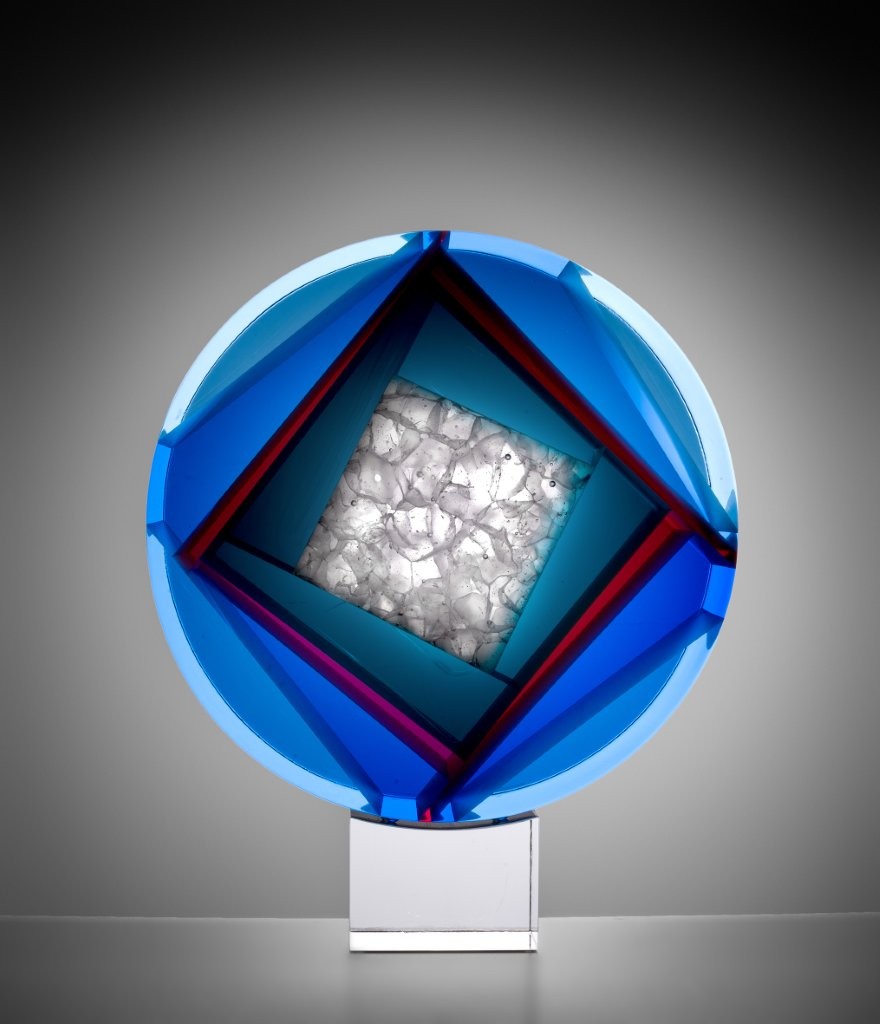
The work Nebula from 2020 is based on a powerful contrast between precision and irregularity. At first glance, it appears almost like an optical construction: a circular outer form encloses a sequence of square and diamond-shaped layers that gradually converge towards the centre. There, the regular geometry suddenly changes and gives way to a more organic, lighter structure. It is precisely this centre that forms one of the most fascinating elements of the entire work.
Petra Hřebačková used glass ends created during the process of blowing glass on a blowpipe and fused them together into a single compact whole. A material that would otherwise remain merely a natural trace of the production process is thus given a new artistic function and becomes the very core of the sculpture. The result is an object that appears as though it genuinely contains its own inner luminous space.
Nebula is built on the relationship between two fundamental principles. The circle creates a calm, enclosed frame. The inner square layers, however, are rotated in relation to it, and their edges gradually guide the eye inward. Their progressive reduction in size creates an effect similar to perspective. The viewer therefore does not feel as though they are looking merely at the surface of the object.
The dominant blue colour further intensifies this effect. For Nebula, Petra Hřebačková used blue glass from the Moser glassworks, a material associated with one of the most significant traditions of Czech glassmaking. Within the work, however, it does not function as a historical reference or nostalgic element. The artist uses it in a distinctly contemporary way – as a means of creating chromatic depth, transparency and optical tension.
The blue surfaces vary in intensity across different parts of the object. In some areas, they appear light and translucent; elsewhere, the thickness of the material makes the colour optically denser and darker. Narrow red lines separate the individual layers, emphasise their direction and help guide the eye through the geometric structure of the composition.
The strongest contrast, however, appears in the centre. While the surrounding layers are precise, controlled and geometrically clear, the central section formed from fused glass ends is naturally irregular. Each individual piece has a different shape, subtle deformation and optical structure. This introduces an element of chance and authenticity into an otherwise highly disciplined composition.
These elements are not merely abstract material. They carry within them the trace of a specific method of production. They were created during the glassblower’s work at the blowpipe, and their origin is directly connected with the traditional process of blown glass. Petra Hřebačková neither conceals this material nor transforms it beyond recognition. On the contrary, she places it precisely at the centre of the composition. She gives it a new place and a new meaning.
The clarity of the finished object depends on highly precise work. The coloured layers must be prepared so that, after thermal processing and subsequent cooling, they form the intended structure. Controlled cooling is essential in massive glass because the material develops internal stress as its temperature changes. Once cooled, the glass is ground.
The ground surfaces determine not only the final form but also the way light enters the object and refracts within it. In a work based on precise layering, every edge is important. Final polishing then optically opens the transparent glass and allows the viewer to follow the individual layers genuinely deep into the material.
Technology is therefore not merely a means to an end here. It is directly part of the final visual effect. Nebula has a very strong frontal composition, so it benefits from being placed where it can be viewed directly and from a certain distance. It works well on an independent plinth, console or chest of drawers against a calm background.
Against a light wall, the transparency and blue colour become more pronounced. A darker background, by contrast, emphasises the luminous character of the centre and can give the work a more dramatic presence. Lighting is equally important. Soft frontal light supports the geometry, while side lighting emphasises the thickness of the glass, the depth of colour and the contrast between the precise layers and the irregular centre.
For collectors, Nebula is particularly interesting because it combines several distinct levels. There is the strong geometric composition, the use of blue glass from the Moser glassworks, and the material trace of traditional glassblowing in the form of fused ends from the blowpipe. The work thus connects a contemporary artistic approach with the specific physical memory of Czech glassmaking craftsmanship.
From a distance, it appears almost perfectly geometric. Up close, it begins to break down into irregularities, subtle structures and material traces. Nebula is not merely an optical play with depth. It is a meeting between precisely controlled construction and a material that carries within it the direct trace of human labour and of the process of making glass itself.
More about the artist >>> here <<<
More works by Petra Hřebačková >>> here <<<